End-to-end encrypted.
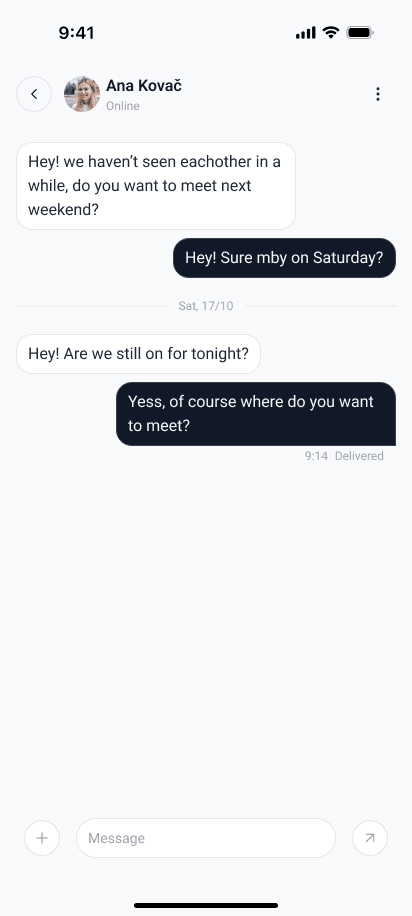
Your messages are encrypted before they leave your device. Only you and the people you send them to can read them.


Because real privacy means nobody can read your messages, even if someone tries to make us.
Your messages are encrypted before they leave your device. Only you and the people you send them to can read them.
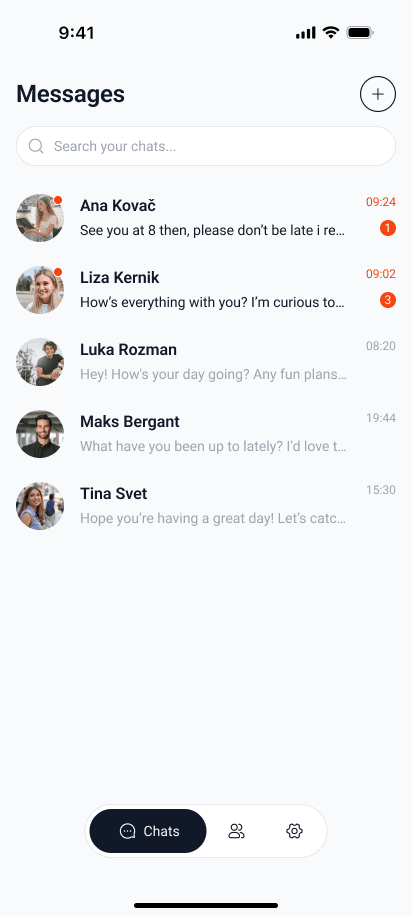
Once delivered, your messages are removed from our servers and stored on your phone.
We believe privacy is a right, technology should serve people, and no company should hold unchecked power over our private lives.
Via is built here to defend what we believe Europe stands for: privacy, dignity, freedom, and accountable technology.
Because we think Europe should build its own technology rather than rent it, and private messaging is a good place to start. Most of us depend every day on platforms built elsewhere, around values and business models that are not our own.
So privacy is Via's foundation rather than one of its features: messages are end-to-end encrypted, your history stays on your phone, and we keep only what the service needs to run. We are four people from Slovenia paying for it ourselves, and we are not building an advertising platform.
Your messages are encrypted on your phone before they are sent. The keys needed to unlock them are generated on your device and securely shared only with the devices of the people in the conversation. Via's servers deliver the encrypted messages, but never receive the keys needed to read them.
Via stores a small amount of metadata needed to make the service work, such as account and device identifiers, message-delivery information, limited information needed to operate groups, and a hashed version of your phone number.
A hash is a one-way transformation of your phone number into a code that cannot simply be read back. It lets Via recognise matching accounts without keeping phone numbers in plain text. This means your phone number cannot be directly read from Via's stored account data and remains private.
If you delete your account, your account data is deleted from Via's servers and your Via data is removed from your phone. Two things outlive it: messages you have already sent stay queued until the recipient's device collects them, and records such as an abuse report keep the retention periods in the Privacy Policy. Messages already delivered to other people will remain on their devices.
Once delivered, your messages are removed from our servers and stored only on your phone. Messages waiting to be delivered may remain temporarily on our servers, but they are end-to-end encrypted and unreadable to Via.
This provides stronger privacy, but it also means there is currently no cloud backup of your message history.
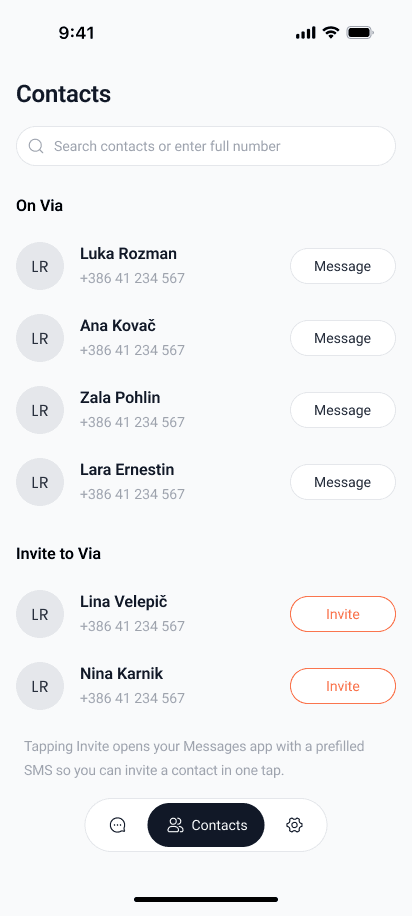
Via launches across the European Union first, so you can download it in any EU country. Accounts are verified by phone number, and for now that number has to carry an EU country code — so you will need one to sign up. We plan to open Via up beyond the EU as it grows.
We are pro-European, and not decoratively so. Via exists because we believe Europe should build and run its own digital infrastructure rather than rent it, and that organising at a European scale is worth doing.
Chat Control is not that. We think it is a bad law. Searching through private messages in case someone has something to hide treats every European as a suspect, and we do not believe it would make our societies safer.
It is also incompatible with how Via is built. There is no way to hand a public institution a readable copy of your messages and still call those messages end-to-end encrypted — a door we can open is a door we can be ordered to open. If Chat Control passes and we were compelled to decrypt our users' messages, we would shut Via down rather than comply.
Images, for now, and they are end-to-end encrypted like everything else you send. Support for other kinds of files is among the updates we want to introduce next.
Not yet. We are beginning with private messaging to see whether people want a European service like Via. Voice and video calls are among the updates we want to introduce next.
A Via group can currently have up to 25 people.
Not yet. Via is launching on mobile first, with desktop and web versions coming in a future update. You'll be able to continue your conversations across devices while keeping the same end-to-end encryption.
For now, your Via account can be active on one phone at a time. Multi-device support is coming in a future update, allowing you to securely link additional devices while keeping your conversations end-to-end encrypted.
Via is for people aged 16 and over. You give your date of birth when you create an account, and it is used to check that — Via does not show it to anyone else.